#23: Gawker
The snarky website returns - and, for all its aloofness, there's good writing to be had.

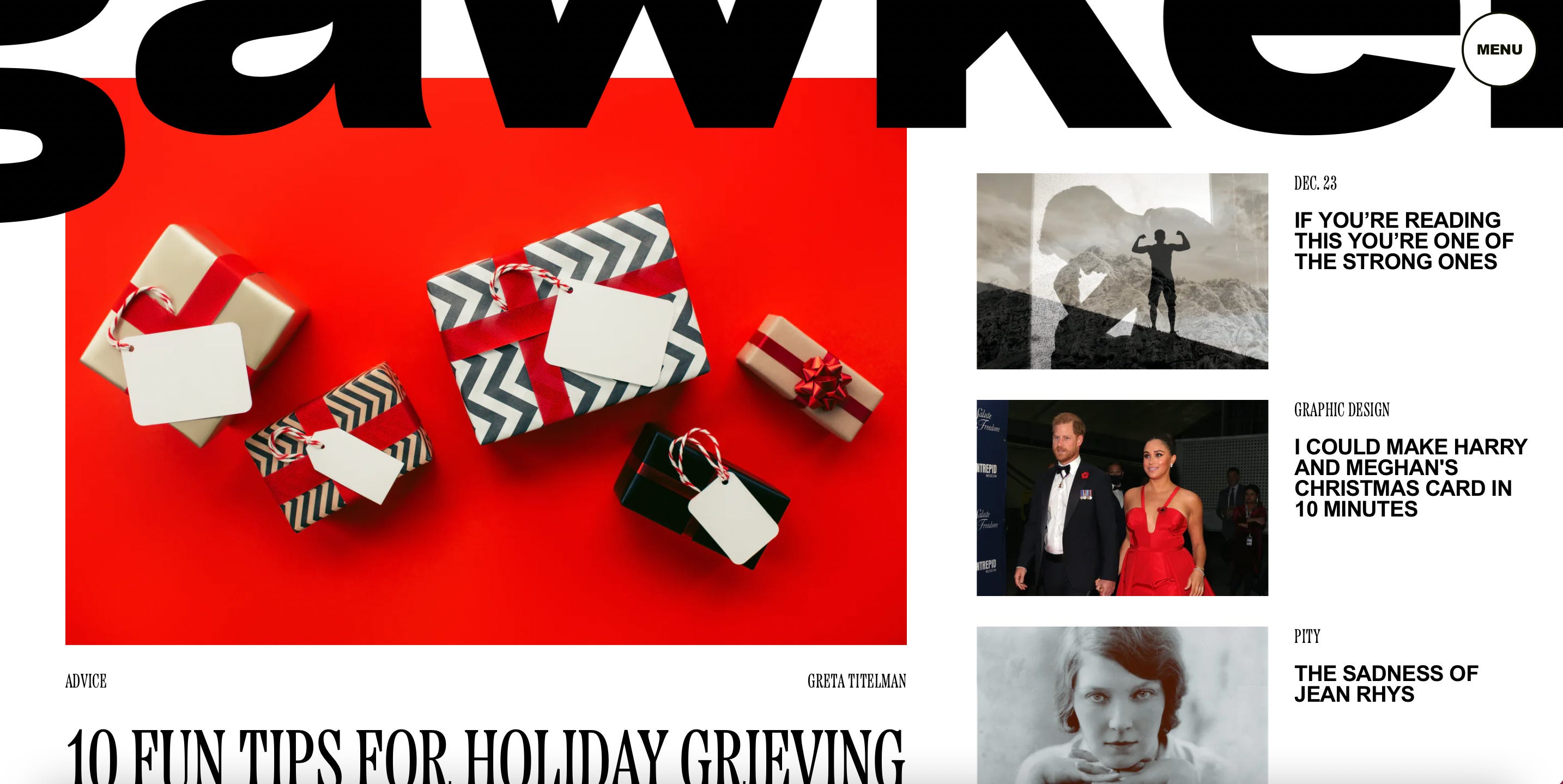
In many respects, spotlighting the Gawker reboot feels like the antithesis of the project I set out for this year’s Critmas at the beginning. Gawker as a website has rarely been thought of as ‘sincere’: sharp, snarky, unapologetically gossipy…even ‘incredibly New York media’ come to mind. But credit where credit is due: over the past year, it’s published some insightful articles on topics which speak to ‘a’ if not ‘the’ current mood.
My picks:
True Crime is Rotting Our Brains - the author, Emma Berquist, was the victim of a random stabbing in broad daylight that would be of deep interest to a lot of the sort of content (largely podcasts), the article laments. In light of the despicable murder of Sarah Everard by a police officer who used lockdown rules and the authority of the badge for his attack, the topic of women’s safety at night has been a fraught one this year. And it’s one that has been capitalised on in increasingly unseemly ways: the other week I saw an influencer I follow, Lucy Moon, do a sponsored campaign with Uber as I was scrolling through Instagram, focusing on their safety measures. What happens when we suggest that the night is only available to women if they travel via taxi? What happened to movements like Reclaim the Night?
Berquist notes the normalisation of what in CBT I learnt of as ‘safety behaviours’ that the true crime brain can encourage - and while it’s relevant in the context of discussions around ‘safety’, this sort of thing is particularly worrisome during a pandemic, where people are more likely than usual to seek out ways of clawing back order or sense when locked down or undersocialised.
Hypervigilance is a common symptom of PTSD, a trauma response that constantly puts your body into fight-or-flight mode. I have to tell myself that it’s ok to have someone walking a few steps behind me, that no one is waiting for me to let my guard down. In the first few months after my attack, I would panic hearing someone at my back. I bought a personal safety device, something that I could press to send a loud alarm that’s supposed to scare attackers off. Once my car keys fell out of my pocket and the noise might as well have been a gunshot the way I reacted. It got easier the more I went out, but it took me half a year to be able to go for a walk with my earbuds in again. All these things — constantly looking behind you, carrying a safety device, always being hyper-aware — these aren’t normal ways to live. It’s not healthy, and it’s certainly not sustainable. And yet I see women proclaiming that this is necessary, that this is the way you need to move through the world as a woman. I see women choosing to live the way I’m fighting to overcome.
Sally Rooney is Irish - I didn’t engage in much criticism on Beautiful World, Where Are You because at this stage in the Rooney project, I feel it more interesting to talk about her work to people than read formal responses that are unsure what to do with the bestseller, but this was an exception. Rooney is Irish and writes about a post-Celtic Tiger, post-crash, only just post-Repeal Ireland. That context matters and is often overlooked in American and British readings of her work.
The Cultural Revisionism Industry - It would be remiss of me not to share this, given there have been two entries that relate to debunking podcast You’re Wrong About over the 2020 and 2021 editions of Critmas, weirdly both on the 18th.
It’s a reflection on the thing that can sit at the heart of the great debunking wave - as the author notes, it’s true crime for people who have issues with true crime. And I have done, for several years - here’s a blog post I wrote back in October 2014 (! embarrassingly, I’m still surprised I have a digital footprint as long as I do, but pleasantly nice to see I was writing stuff during a period of post-grad unemployed depression that I’m happy to share today) in response to the podcast Serial, whose first season was still unfolding. The subtitle? Should I be as entertained by the true-life case of a murder as I currently am?
“It’s less ‘You’re Wrong About’ and more, ‘Other People Are Wrong About,’” Jack Hamilton, a professor of media studies at University of Virginia, told me over the phone. He’s listened to many episodes of “You’re Wrong About,” and believes that the show may be popular in part because of its failure to deliver any real bombshells. “It’s reaffirming what audiences know or suspect a lot of the time, and by framing it as, ‘everything that everyone believes about this is wrong,’ ’it flatters the viewer or listener. You can think, ‘I was one of the ones who was right about this.’”
The other thing with Gawker is that these articles are worth sharing because they’ve been decently edited, which is important! Much as I love writing Critmas and my other newsletter, working with good editors, this year at Bustle, Exeunt and Kinfolk, really does make your arguments sing in ways the unfiltered you might struggle to.